
Spatial Data Analysis & GIS in R
This online course provides a comprehensive introduction to spatial data analysis and Geographic Information Systems (GIS) using the R programming language. It covers essential concepts, data manipulation, visualization, and analytical techniques for geospatial data. Participants gain practical skills to work with various spatial datasets and perform advanced analyses.
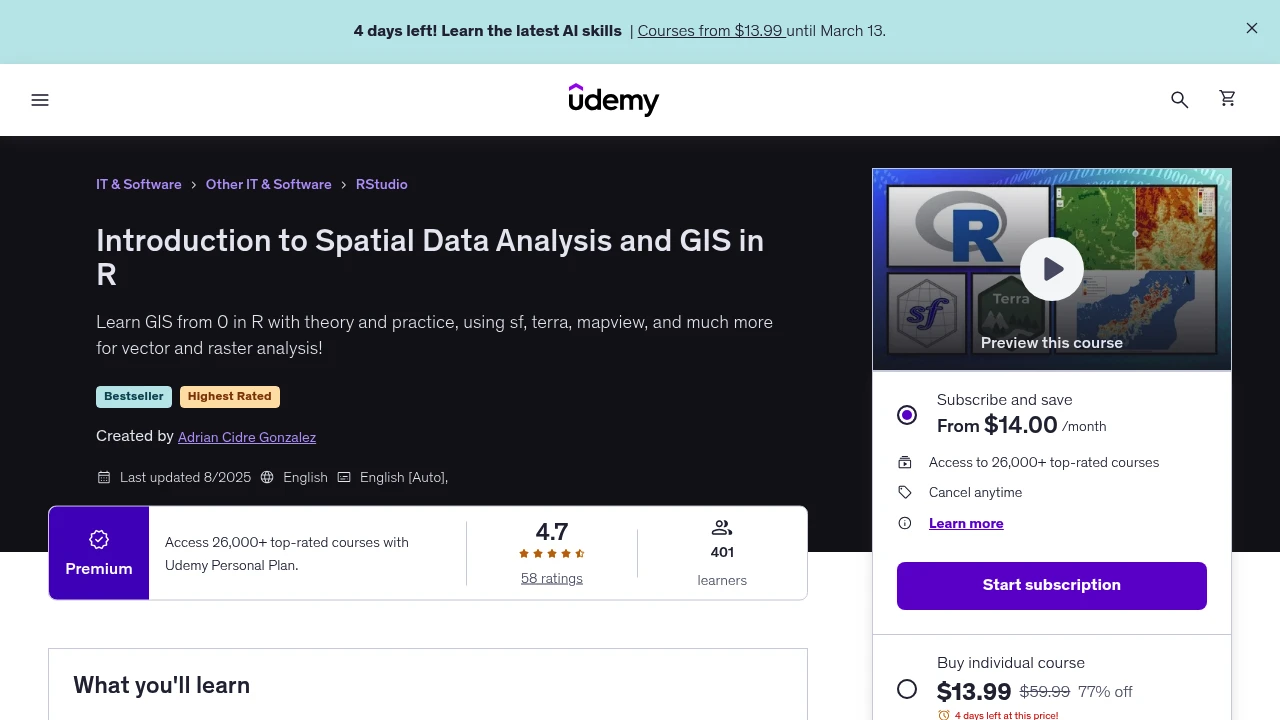
This online course offers a comprehensive introduction to spatial data analysis and Geographic Information Systems (GIS), specifically tailored for users of the R programming language. It guides learners through the fundamental concepts and practical applications required to effectively work with geospatial data. The curriculum is designed to build a strong foundation in handling, visualizing, and analyzing spatial information, making complex spatial concepts accessible to a broad audience.
Participants will explore various techniques for importing, manipulating, and visualizing spatial datasets within the R environment. The course covers essential topics such as understanding different spatial data types (e.g., points, lines, polygons, rasters), working with coordinate reference systems and projections, performing spatial queries, and creating informative maps. It delves into advanced analytical methods, including spatial interpolation, overlay analysis, and basic geostatistical techniques, providing a robust toolkit for diverse geospatial challenges. The course emphasizes hands-on exercises and practical case studies, allowing learners to apply theoretical knowledge to real-world scenarios and develop proficiency in R's extensive geospatial packages like sf, terra, and tmap.
Upon completion, individuals will possess the skills to conduct basic to intermediate spatial analyses, interpret results, and communicate findings through compelling visualizations. This makes the course particularly valuable for students, researchers, and professionals across disciplines such as environmental science, urban planning, public health, and ecology who need to integrate spatial thinking and data-driven insights into their work. The practical skills gained are directly transferable, enabling participants to confidently tackle their own spatial data projects and contribute to data-informed decision-making.
Disclaimer: We do not guarantee the accuracy of this information. Our documentation of this website on Geospatial Catalog does not represent any association between Geospatial Catalog and this listing. This summary may contain errors or inaccuracies.
Comments (0)
Sign in to leave a comment