
MobilityDB
MobilityDB is a database management system designed for moving object geospatial trajectories, such as GPS traces. It extends PostgreSQL and PostGIS by adding robust support for temporal and spatio-temporal objects, enabling advanced data management and analysis capabilities.
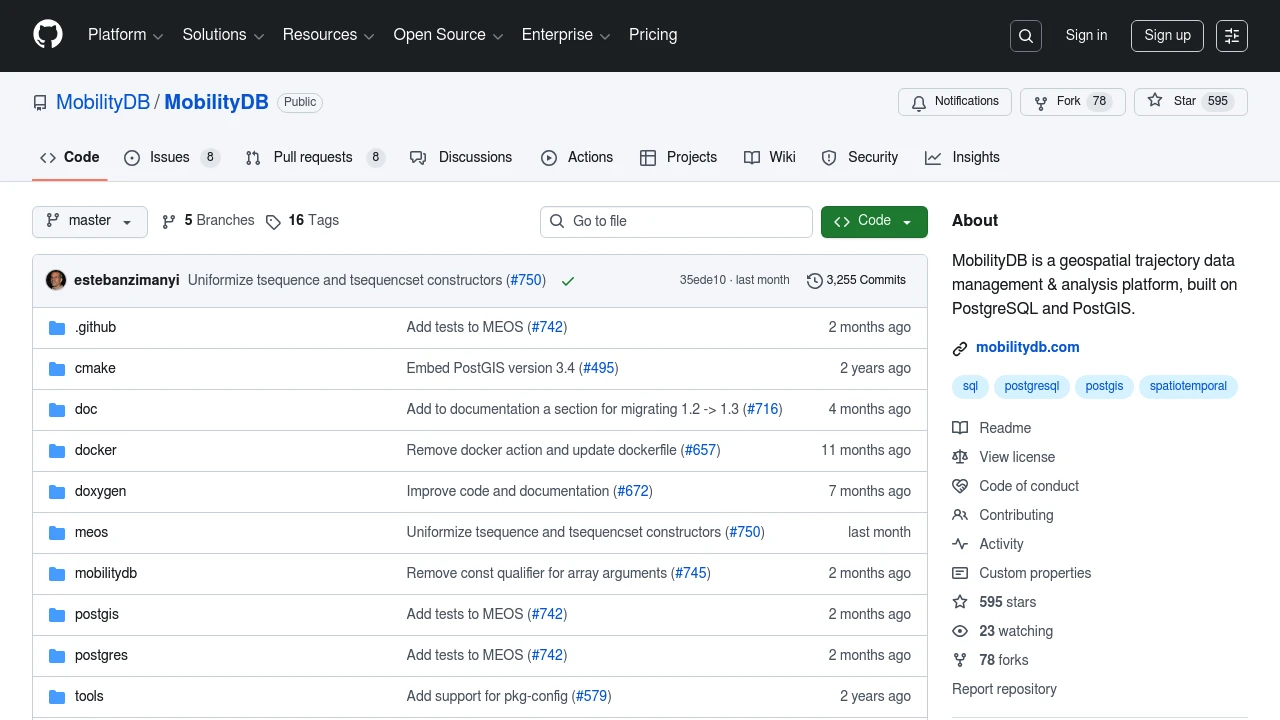
MobilityDB functions as an open-source geospatial trajectory data management and analysis platform. It is specifically engineered to handle moving object geospatial trajectories, such as those generated by GPS devices, vehicle tracking systems, or even wildlife movement. The platform is built upon the robust foundations of PostgreSQL and its powerful spatial extension, PostGIS, leveraging their capabilities to efficiently store, index, and query complex spatial data. This integration provides a familiar and scalable environment for developers and data scientists working with location-aware datasets.
This system significantly enhances traditional database functionalities by introducing comprehensive support for temporal and spatio-temporal objects. It allows for the definition and manipulation of data types that inherently understand movement through both space and time. This capability provides a powerful framework for understanding dynamic phenomena, enabling users to perform advanced queries on historical trajectories, analyze movement patterns, detect anomalies, and predict future positions. MobilityDB is a project developed by the Computer & Decision Engineering Department of the Université Libre de Bruxelles (ULB), an OGC Associate Member, contributing to the advancement of open geospatial standards.
The platform is designed to facilitate the efficient storage, querying, and analysis of large volumes of trajectory data, making it suitable for various applications. These include optimizing routes in transportation and logistics, monitoring environmental changes, understanding urban mobility patterns, and tracking assets. Its deep integration with established database technologies ensures high reliability, performance, and scalability, addressing the complex demands of modern geospatial data challenges and providing a solid foundation for building sophisticated location-based services.
Disclaimer: We do not guarantee the accuracy of this information. Our documentation of this website on Geospatial Catalog does not represent any association between Geospatial Catalog and this listing. This summary may contain errors or inaccuracies.
Comments (0)
Sign in to leave a comment